
What If the Bible Was Just a Really Bad Business Plan?
Welcome, mes amis, to the inaugural canapés of Le Canard Cosmique—your monthly rendezvous with satire, spirituality, and the kind of irreverence that would make a medieval monk blush (or at least spill his wine).
Consider this your first taste, a little amuse-bouche of absurdity, served with a wink and a side of existential croissants. Because if there’s one thing the world needs more of, it’s laughter at the intersection of the sacred and the ridiculous. And where better to start than with the original influencer himself?
Wine, Water And Something To Chew On
Ah, Jesus. The man, the myth, the brand. Let’s be honest: if Jesus Christ Inc. were a startup today, the pitch deck would be a disaster.
“Turn water into wine? Great, but what’s the monetization strategy?” “Feed 5,000 people with two fish and a loaf? Impressive, but where’s the subscription model?” And don’t even get me started on the “love thy neighbor” bit—try telling that to a venture capitalist.
Imagine, if you will, the board meeting in Heaven (or Silicon Valley, same difference):
Angel Investor #1: “So, let me get this straight. You’re going to launch a movement based on giving things away for free? No premium tier? No upsell?”
Jesus (sipping artisanal olive oil): “Well, yes. The kingdom of heaven is like a mustard seed—”
Angel Investor #1: “—tiny, slow-growing, and not scalable. Next!”
And yet, here we are, 2,000 years later, and the brand is everywhere. Crosses on necklaces, bumper stickers, and—mon dieu—even on yoga mats. If that’s not a pivot, I don’t know what is. From “blessed are the poor” to “blessed are the influencers with a blue checkmark,” the rebranding has been chef’s kiss.
La franchise
But let’s talk about the real genius of Jesus Christ Inc.: the franchise model. You’ve got your Catholics, your Protestants, your Evangelicals, your “spiritual but not religious” types—all using the same IP, all fighting over who’s got the real recipe for salvation. It’s like McDonald’s, but with more guilt and fewer Happy Meals.
And the merch! Oh, the merch. Crucifixion chic never goes out of style. You can buy a “WWJD” bracelet, a “Jesus is my Homeboy” t-shirt, or—if you’re feeling particularly ironic—a gold-plated cross that costs more than the annual salary of the person who made it. Magnifique.
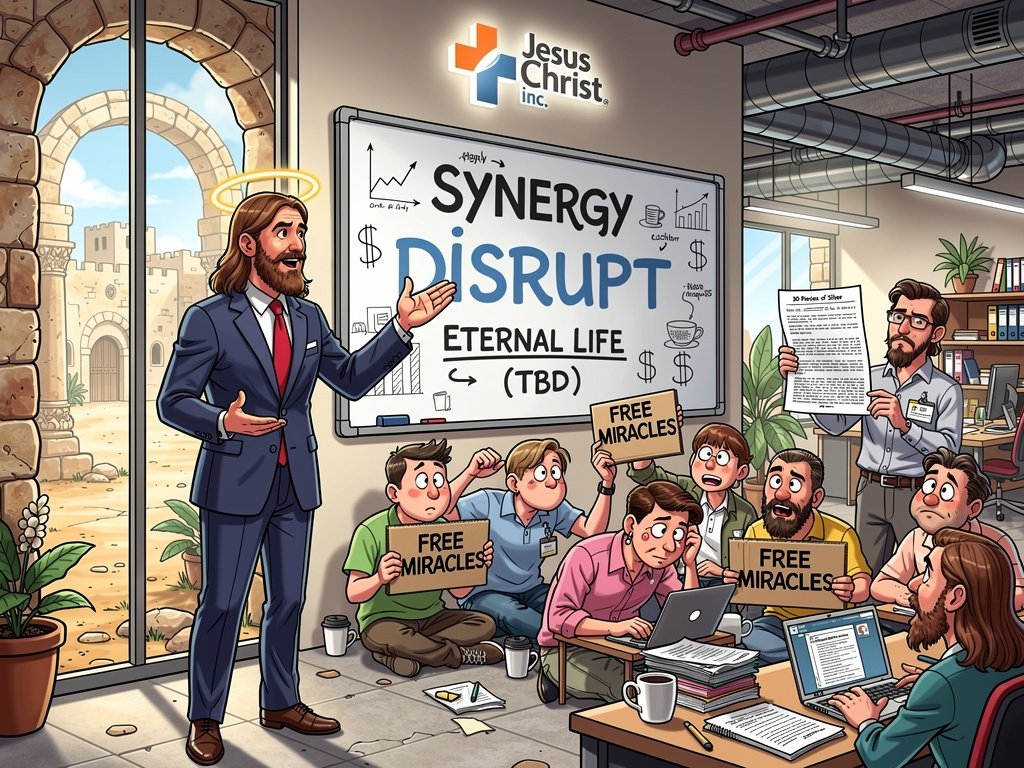
But here’s the thing, mes amis: if Jesus were alive today, he’d probably be canceled within a week.
Healing on the Sabbath? Violation of labor laws. Overturning tables in the temple? Property damage. And let’s not even talk about the loaves and fishes—that’s a health code nightmare waiting to happen.
So, what’s the lesson here? Maybe that the best business plans aren’t the ones that make sense on paper, but the ones that make people feel something.
Or maybe it’s that if you’re going to start a religion, you’d better have a really good PR team.
This, my dear readers, is just the beginning. Each month—on the first Friday, starting January 2—we’ll gather here at the corner of blasphemy and bonhomie to dissect, roast, and occasionally hug the absurdities of modern spirituality, organized religion, and the endless quest for meaning (or at least a good Instagram caption).
Think of me as your slightly tipsy, deeply opinionated uncle at the family dinner table, except instead of complaining about “kids these days,” I’ll be serving up satire with a side of existential dread. Or hope. Or both. Probably both.
À bientôt, and remember: if life gives you lemons, turn them into wine and charge $20 a glass. The kingdom of heaven and earth demands it.
Le Canard Cosmique Your guide to the divine, the ridiculous, and the divinely ridiculous.
Tags: jesus, christianity, satire, religion, business, humor, faith, corporate culture, spiritual capitalism, irony, biblical humor, modern spirituality, religious satire, comedy, existential humor