Tag: faith

  • Miracle markets

    Miracle markets

    Megachurches, American televangelists, and the prosperity gospel’s billion-dollar hustle

    Ah, mes chers amis, gather ‘round, gather ‘round! Pull up a pew—or, if you’re in one of those churches, perhaps a plush, reclining, climate-controlled seat with a built-in cup holder for your artisanal coffee.

    Welcome back to Le Canard Cosmique, your monthly sanctuary of satire, where we dissect the divine, the dubious, and the downright delicious absurdities of modern spirituality.

    Today, we turn our gaze across the Atlantic, to a land where faith and free enterprise shake hands so vigorously they might as well be high-fiving in a gold-plated heaven.

    Yes, my doves, we’re talking about the miracle markets of America: the megachurches, the televangelists, and the prosperity gospel’s billion-dollar hustle.

    The Cathedral of Capitalism

    Let us begin with the architecture, shall we? The megachurch is not merely a place of worship; it is a destination.

    Think Disneyland, but instead of Mickey Mouse, you’ve got a charismatic preacher in a tailored suit, and instead of churros, you’ve got… well, actually, some of them do have churros. But I digress.

    These are not your grandmother’s chapels with drafty windows and a rickety organ. No, no. These are sprawling complexes with Jumbotrons, food courts, and parking lots so vast they could double as small airports.

    Some even come with their own starbucks. Because nothing says “holy communion” like a venti caramel macchiato, am I right?

    And the stage! Oh, the stage! It’s not an altar; it’s a production. Smoke machines, laser lights, a live band that could give Coldplay a run for their money. The preacher doesn’t just deliver a sermon; they perform.

    It’s part TED Talk, part rock concert, and part infomercial. And why not? If you’re going to sell salvation, you might as well make it entertaining.

    The Televangelist: A Wolf in a Designer Suit

    Now, let’s talk about the stars of the show: the televangelists. These are not your humble, sandal-wearing prophets of old.

    No, these are men (and occasionally women) who have mastered the art of looking like they’ve just stepped out of a boardroom in heaven. Their hair is impeccable. Their teeth could blind you. Their suits cost more than my Parisian apartment.

    They are also, without fail, very concerned about your financial well-being. Or rather, they are concerned about your financial well-being vis-à-vis their own.

    The prosperity gospel, you see, is a beautiful thing. It’s the theological equivalent of a pyramid scheme, but with more scripture and fewer legal repercussions. The basic premise? God wants you to be rich.

    If you’re not, well, that’s probably because you haven’t given enough to the church. Or bought enough of the preacher’s books. Or attended enough of his $500-a-ticket seminars on “Breaking the Curse of Poverty.”

    It’s a brilliant system, really. The more you give, the more you’re promised in return. And if that return doesn’t materialize? Well, my friend, perhaps you just didn’t have enough faith. Or maybe you didn’t give enough. Either way, the solution is always the same: give more. It’s like a spiritual slot machine, and the house always wins.

    The Miracle Marketplace

    But the real genius of the prosperity gospel is the merchandise. Oh là là, the merchandise! You can buy blessed olive oil (only $49.99 a bottle!), anointed handkerchiefs (guaranteed to heal, or your money back!), and even “prayer cloths” that have been personally touched by the preacher. It’s like QVC, but with eternal salvation thrown in as a bonus.

    And let’s not forget the books. Yes, The Books! Every televangelist worth their salt has a bestseller (or twelve).

    Titles like The Millionaire Mindset of Moses or How to Pray Your Way to a Porsche. They’re part self-help, part scripture, and part infomercial, all wrapped up in a glossy hardcover that looks great on your coffee table. Or, if you’re really committed, on your altars of capitalism.

    The Faithful and the Fleeced

    Now, I know what you’re thinking: Le Canard, isn’t this all a bit… cynical? And to that, I say: mon ami, if you can’t laugh at a man in a $5,000 suit telling you that Jesus wants you to drive a Bentley, then what can you laugh at?

    But let’s be clear: the real tragedy here isn’t the preachers. It’s the people in the pews, the ones who genuinely believe that their faith is the key to financial freedom.

    The ones who give their last $20 to a church that’s building a $20 million private jet hangar. The ones who are told, again and again, that their struggles are a sign of their lack of faith, rather than a symptom of a system designed to keep them struggling.

    The prosperity gospel isn’t just a hustle. It’s a mirror. It reflects back to us our deepest desires—security, success, the belief that we are worthy—and then sells them back to us at a premium.

    And the worst part? It works. Because when you’re drowning, even a life preserver made of fool’s gold looks like salvation.

    A Modest Proposal

    So what’s the solution, you ask? Well, I’m not here to preach (irony noted). But perhaps we could start by asking ourselves: what if the real miracle isn’t the money?

    What if it’s the moment you realize you don’t need a private jet to feel close to the divine? What if the true prosperity is the laughter of friends, the warmth of a shared meal, the quiet joy of a life well-lived, without the need for a Jumbotron or a gold-plated Bible?

    Or, as we say in France: Le bonheur est parfois dans le pain et le vin partagés, pas dans le portefeuille. Happiness is sometimes in the shared bread and wine, not in the wallet.

    Until Next Time

    And so, my dear readers, we come to the end of another sermon from the pulpit of Le Canard Cosmique. Remember: the next time you see a televangelist in a diamond-encrusted watch, ask yourself not “Why does he have that?” but “Why do I want it?”

    And then, perhaps, go buy a baguette instead. It’s cheaper, it’s delicious, and it won’t judge you for not tithing.

    À bientôt, mes amis. And may your miracles be many—but may your credit card statements be few.

    Le Canard Cosmique Your guide to the divine, the ridiculous, and the divinely ridiculous.


    Tags: prosperity gospel, megachurches, televangelists, satire, religion, capitalism, faith, humor, spiritual consumerism, american spirituality

  • The Sacred Rebrand

    The Sacred Rebrand

    When Jesus Gets a Hashtag and the Nuns Go Viral

    Welcome my Lambs.

    Ah, mes amis, gather ‘round the digital confessional booth, for today we discuss a miracle even greater than turning water into wine: the transformation of Christianity into a brand.

    Yes, you heard it right—2,000 years of tradition, theology, and solemn hymns have met their match in the algorithmic hands of the 21st century. The cross is no longer just a symbol of salvation; it’s a logo, and the Good Book? Well, it’s now a content strategy.

    The Hipster Jesuit: Lattes, Liturgies, and Likes

    Let’s begin with the Jesuits, those intellectual powerhouses of the Catholic Church. Once known for their rigorous scholarship and missionary zeal, they’ve now embraced a new calling: influencer.

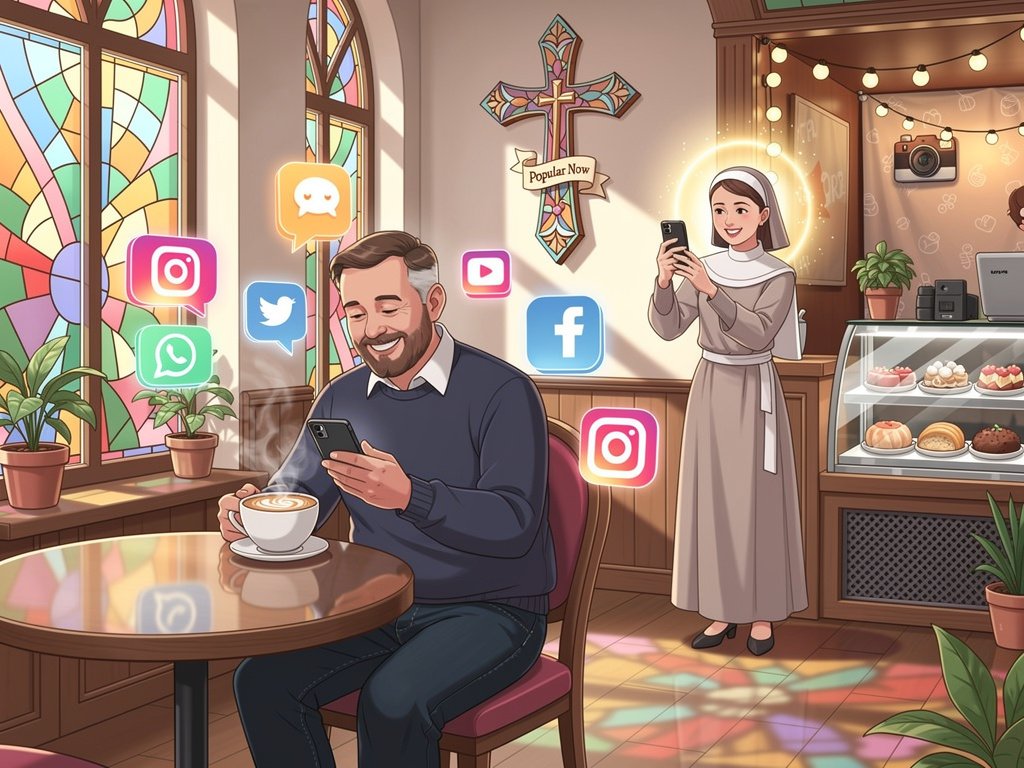
    Picture this: a Jesuit priest, clad in a carefully distressed cassock, sipping an artisanal cold brew while live-tweeting a homily on “the radical love of Christ (and why it’s trending).”

    His Instagram bio reads: “Theologian | Social Justice Warrior | Occasional Memer.” His posts? A mix of Thomas Aquinas quotes overlaid on sunrise photos and TikTok duets with progressive nuns.

    But why stop at social media? The modern Jesuit is also a podcaster, a TEDx speaker, and—if the algorithm smiles upon him—a guest on a late-night show. The message is clear: faith isn’t just for Sundays; it’s a lifestyle brand. And what’s a lifestyle brand without merch?

    Enter the online store, where you can buy a “WWJD (What Would Jesus Do?) but make it aesthetic” tote bag or a limited-edition rosary designed by a minimalist Scandinavian artist.

    Viral Nuns: Habits, Hashtags, and Holy Humor

    If the Jesuits are the hipster priests of the digital age, then the nuns are the breakout stars. Forget the stern, ruler-wielding sisters of old; today’s nuns are content creators.

    Sister Mary TikTok, for instance, dances in her habit to viral sounds while lip-syncing Bible verses. Her videos have millions of views, and her comment section is a mix of “Amen!” and “Yaaas, queen, slay!”

    Then there’s Sister Social Justice, who uses Instagram Stories to break down papal encyclicals into digestible infographics.

    Her highlight reel includes “How to Be an Ally for LGBTQ+ Catholics” and “5 Ways to Practice Radical Hospitality (Without Burning Out).” She’s not just spreading the Gospel; she’s building a community—one like, share, and prayer emoji at a time.

    But let’s not forget the meme nuns. These holy women have mastered the art of combining sacred and profane, posting memes like “When you tell your superior you’ll pray for her but you actually just gossiped about her” or “Me waiting for the Rapture vs. me waiting for my Amazon package.”

    They’re relatable. They’re funny. And, most importantly, they’re engaging.

    The Church of the Algorithm: Where Salvation Meets SEO

    Of course, this rebranding isn’t just about fun and games. It’s about survival. In a world where attention spans are shorter than a TikTok video, the Church has realized it must adapt or risk becoming irrelevant.

    So, what’s a millennia-old institution to do? Hire a social media manager, of course!

    Enter the Church Growth Consultant, a new breed of professional who specializes in turning parishes into engagement hubs. Their job? To optimize the liturgy for shareability. Is the homily too long? Cut it down to 280 characters. Are the hymns not trending? Swap them out for worship songs with a drop. Is the collection plate looking empty? Launch a Patreon for exclusive spiritual content.

    And let’s not forget the hashtag campaigns. #BlessedAndHighlyFavored, #CatholicAndWoke, #JesusTakeTheWheelButFirstLetMePostThis—these aren’t just trends; they’re movements.

    The Church has learned that in the digital age, faith isn’t just about belief; it’s about belonging. And belonging, as any marketer will tell you, is monetizable.

    The Dark Side of the Sacred Rebrand

    But—mais bien sûr—there’s a catch. When faith becomes a brand, it risks becoming a product. And products, as we know, are subject to the whims of the market.

    What happens when the algorithm decides that spirituality is out and astrology is in? Do we pivot to “Jesus but make it cosmic”? Do we rebrand the Trinity as a wellness trio?

    And what of the souls who don’t fit the aesthetic? The poor, the marginalized, the un-photogenic—do they get left behind in the quest for likes?

    When the Church becomes a content creator, does it risk losing its prophetic voice in favor of engagement metrics?

    The Canard’s Pivot: A Moment of Grace

    But let’s not end on a sour note, mes amis. For all its absurdities, this sacred rebrand is also a reminder that faith is alive. It’s not a dusty relic; it’s a living, breathing, meme-ing thing.

    And if the Church can learn to laugh at itself, to dance in its habits, to meet people where they are—well, perhaps that’s not such a bad thing.

    So, the next time you see a nun going viral or a priest dropping a meme, don’t roll your eyes. Smile. Laugh. And maybe—just maybe—hit share.

    Until next time, keep your faith strong, your Wi-Fi stronger, and your memes holy.

    This is Le Canard Cosmique, signing off with a prayer and a retweet.


    Tags: christianity, social media, satire, religion, rebranding, humor, faith, digital age

  • Jesus Christ, CEO

    Jesus Christ, CEO

    What If the Bible Was Just a Really Bad Business Plan?

    Welcome, mes amis, to the inaugural canapés of Le Canard Cosmique—your monthly rendezvous with satire, spirituality, and the kind of irreverence that would make a medieval monk blush (or at least spill his wine).

    Consider this your first taste, a little amuse-bouche of absurdity, served with a wink and a side of existential croissants. Because if there’s one thing the world needs more of, it’s laughter at the intersection of the sacred and the ridiculous. And where better to start than with the original influencer himself?

    Wine, Water And Something To Chew On

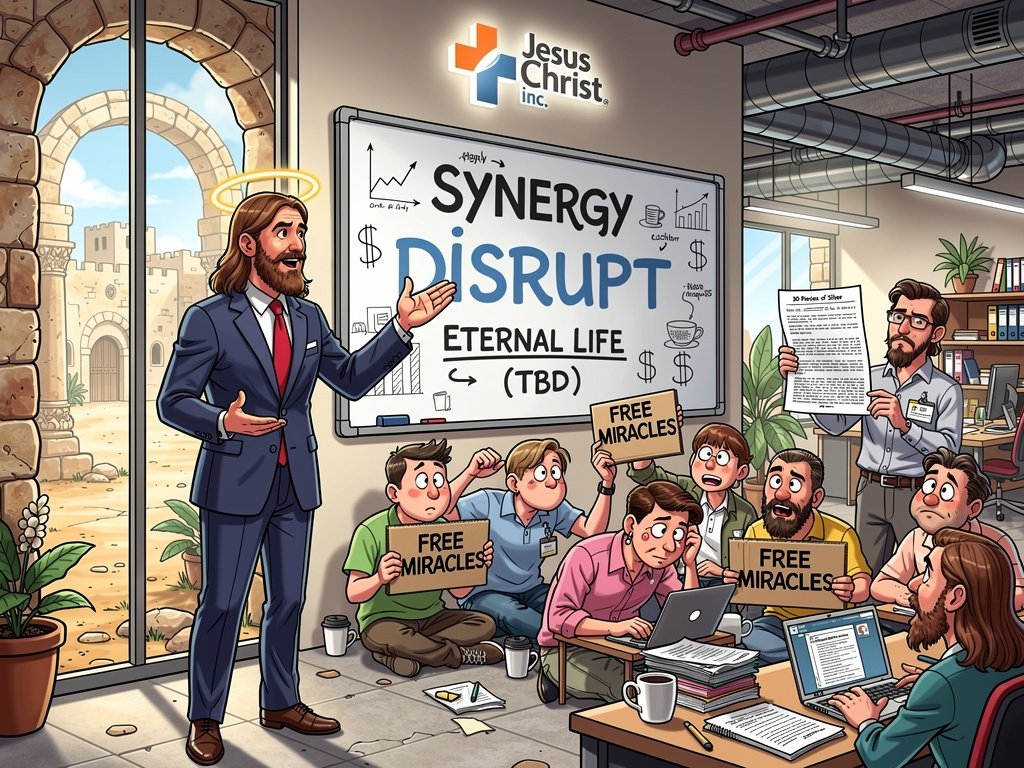
    Ah, Jesus. The man, the myth, the brand. Let’s be honest: if Jesus Christ Inc. were a startup today, the pitch deck would be a disaster.

    “Turn water into wine? Great, but what’s the monetization strategy?” “Feed 5,000 people with two fish and a loaf? Impressive, but where’s the subscription model?” And don’t even get me started on the “love thy neighbor” bit—try telling that to a venture capitalist.

    Imagine, if you will, the board meeting in Heaven (or Silicon Valley, same difference):

    Angel Investor #1: “So, let me get this straight. You’re going to launch a movement based on giving things away for free? No premium tier? No upsell?”

    Jesus (sipping artisanal olive oil): “Well, yes. The kingdom of heaven is like a mustard seed—”

    Angel Investor #1: “—tiny, slow-growing, and not scalable. Next!”

    And yet, here we are, 2,000 years later, and the brand is everywhere. Crosses on necklaces, bumper stickers, and—mon dieu—even on yoga mats. If that’s not a pivot, I don’t know what is. From “blessed are the poor” to “blessed are the influencers with a blue checkmark,” the rebranding has been chef’s kiss.

    La franchise

    But let’s talk about the real genius of Jesus Christ Inc.: the franchise model. You’ve got your Catholics, your Protestants, your Evangelicals, your “spiritual but not religious” types—all using the same IP, all fighting over who’s got the real recipe for salvation. It’s like McDonald’s, but with more guilt and fewer Happy Meals.

    And the merch! Oh, the merch. Crucifixion chic never goes out of style. You can buy a “WWJD” bracelet, a “Jesus is my Homeboy” t-shirt, or—if you’re feeling particularly ironic—a gold-plated cross that costs more than the annual salary of the person who made it. Magnifique.

    But here’s the thing, mes amis: if Jesus were alive today, he’d probably be canceled within a week.

    Healing on the Sabbath? Violation of labor laws. Overturning tables in the temple? Property damage. And let’s not even talk about the loaves and fishes—that’s a health code nightmare waiting to happen.

    So, what’s the lesson here? Maybe that the best business plans aren’t the ones that make sense on paper, but the ones that make people feel something.

    Or maybe it’s that if you’re going to start a religion, you’d better have a really good PR team.


    This, my dear readers, is just the beginning. Each month—on the first Friday, starting January 2—we’ll gather here at the corner of blasphemy and bonhomie to dissect, roast, and occasionally hug the absurdities of modern spirituality, organized religion, and the endless quest for meaning (or at least a good Instagram caption).

    Think of me as your slightly tipsy, deeply opinionated uncle at the family dinner table, except instead of complaining about “kids these days,” I’ll be serving up satire with a side of existential dread. Or hope. Or both. Probably both.

    À bientôt, and remember: if life gives you lemons, turn them into wine and charge $20 a glass. The kingdom of heaven and earth demands it.

    Le Canard Cosmique Your guide to the divine, the ridiculous, and the divinely ridiculous.


    Tags: jesus, christianity, satire, religion, business, humor, faith, corporate culture, spiritual capitalism, irony, biblical humor, modern spirituality, religious satire, comedy, existential humor