When Enlightenment Comes with a Loyalty Card
Ah, Good Friday. A day for reflection, sacrifice, and—if you’re a savvy spiritual entrepreneur—the perfect launch date for your latest limited-time offer on divine wisdom.
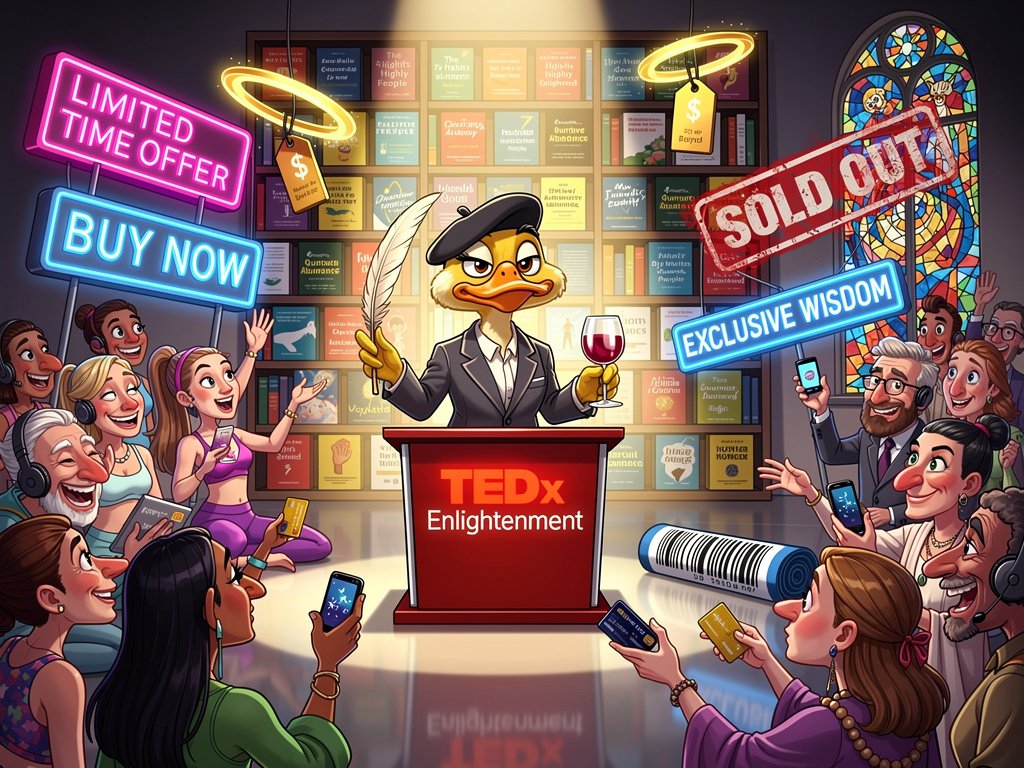
Because nothing says “holy” like a countdown timer and the words “ONLY 3 SPOTS LEFT!” flashing in neon next to a picture of you meditating on a mountaintop (which, let’s be honest, was actually a stock photo taken in your backyard).
Let’s talk about the modern gospel, shall we? Not the one written on stone tablets or whispered in ancient tongues, but the one delivered in 18-minute TED talks, packaged in hardcover books with embossed titles, and sold alongside “exclusive” online courses that promise to unlock the secrets of the universe—for just $997, or three easy payments of $366.66. (Ah, the devil is in the details.)
The Book Deal: How to Turn Your Midlife Crisis into a Manifesto
You know the drill. You wake up one morning, stare into the abyss of your own existential dread, and think: “I should write a book about this.”
And just like that, you’re not just a person with opinions—you’re an author. A thought leader. A visionary.
All you need is a catchy title (“The 7 Habits of Highly Enlightened People Who Also Have Really Great Hair”), a blurb from someone vaguely famous (“This book changed my life!” —Dave, a guy from your yoga class), and a publisher willing to gamble on the fact that at least 5,000 people will buy it because they, too, are desperate for meaning and a 20% discount code.
But here’s the real magic: the book doesn’t even have to be good. It just has to sound good. Throw in some buzzwords—authenticity, alignment, quantum abundance—and you’ve got yourself a bestseller.
Bonus points if you can work in a personal story about overcoming adversity (extra credit if the adversity was a bad breakup or a gluten intolerance). Congratulations! You’ve just monetized your trauma. The American Dream is alive and well, and it’s wearing a linen shirt and selling $400 weekend retreats.
The TED Talk: Where Ideas Go to Become Commodities
Ah, the TED talk. The modern-day sermon, delivered not from a pulpit but from a sleek, red-circled stage, where the lighting is flattering and the audience is full of people who paid $6,000 to feel inspired.
It’s the perfect platform for turning your vaguely formed thoughts into a movement. All you need is a compelling hook (“What if I told you that everything you know about happiness is wrong?”), a personal anecdote involving a near-death experience or a trip to Goa, and a call to action that involves buying your book or signing up for your newsletter.
The beauty of the TED talk is that it doesn’t matter if your idea is original or even particularly coherent. What matters is how you deliver it.
Are you passionate? Do you pause for dramatic effect? Can you make the audience laugh, cry, or—ideally—both within the span of 12 minutes? If so, you’re golden.
And if your talk goes viral? Well, then you’ve officially transcended the realm of mere mortal thinkers. You are now a brand.
The Gospel of Personal Branding: When You Are the Product
Let’s be honest: in the age of the internet, we’re all selling something. Even if that something is just ourselves.
And why not? If you’ve spent years cultivating a persona that’s equal parts wise sage and relatable best friend, it’d be a shame not to monetize it. After all, authenticity is the new currency, and what’s more authentic than turning your soul into a subscription service?
Enter the personal brand: a carefully curated mix of vulnerability and expertise, designed to make you feel like you’re getting to know the real person behind the perfectly filtered photos.
The key is to be just flawed enough to be relatable, but not so flawed that people question your authority.
Share your struggles, but only the ones with happy endings. Talk about your failures, but make sure they’re framed as lessons. And above all, never let them see you sweat—unless it’s in a tastefully shot video about your morning routine, which you’ll later turn into a paid masterclass.
The personal brand is the ultimate paradox: it’s the art of being universal while remaining exclusive. You want everyone to feel like they’re part of your tribe, but you also want them to know that tribe has a velvet rope.
And if they want to get past it? Well, that’s what the $2,000 VIP coaching package is for.
The Irony of It All
Here’s the thing, mes amis: there’s nothing inherently wrong with wanting to share your wisdom or make a living doing it.
The problem isn’t the message; it’s the packaging. When every truth comes with a price tag, when every revelation is just another product launch, we risk losing sight of what matters.
Real wisdom isn’t something you can buy in a bundle or unlock with a promo code. It’s not a limited-time offer or a bonus for referring three friends. It’s messy, unpredictable, and—most importantly—free.
So this Good Friday, as you scroll through your feed and see another ad for a “life-changing” webinar or a “transformational” retreat, ask yourself: what would Jesus do?
Would he drop everything for a 7-day challenge? Would he sign up for a payment plan to access the kingdom of heaven? Or would he flip over the tables of the temple—and maybe unsubscribe from a few email lists while he was at it?
A Final Toast
To the seekers, the skeptics, and everyone who’s ever rolled their eyes at a “once-in-a-lifetime opportunity” that somehow comes around every three months: may your truth be universal, your offers be genuine, and your personal brand be something you’d actually want to have a drink with.
And remember, mon cher: if someone tries to sell you enlightenment, always ask for a receipt. Preferably itemized.
À votre santé, Le Canard Cosmique Your guide to the divine, the ridiculous, and the divinely ridiculous.
Tags: universal truths, personal branding, ted talks, book deals, satire, spirituality, humor, enlightenment for sale, self-help industry, modern gurus, spiritual consumerism, exclusive wisdom, life coaching, irony, le canard cosmique