Tag: religion

  • The Sacred Rebrand

    The Sacred Rebrand

    When Jesus Gets a Hashtag and the Nuns Go Viral

    Welcome my Lambs.

    Ah, mes amis, gather ‘round the digital confessional booth, for today we discuss a miracle even greater than turning water into wine: the transformation of Christianity into a brand.

    Yes, you heard it right—2,000 years of tradition, theology, and solemn hymns have met their match in the algorithmic hands of the 21st century. The cross is no longer just a symbol of salvation; it’s a logo, and the Good Book? Well, it’s now a content strategy.

    The Hipster Jesuit: Lattes, Liturgies, and Likes

    Let’s begin with the Jesuits, those intellectual powerhouses of the Catholic Church. Once known for their rigorous scholarship and missionary zeal, they’ve now embraced a new calling: influencer.

    Picture this: a Jesuit priest, clad in a carefully distressed cassock, sipping an artisanal cold brew while live-tweeting a homily on “the radical love of Christ (and why it’s trending).”

    His Instagram bio reads: “Theologian | Social Justice Warrior | Occasional Memer.” His posts? A mix of Thomas Aquinas quotes overlaid on sunrise photos and TikTok duets with progressive nuns.

    But why stop at social media? The modern Jesuit is also a podcaster, a TEDx speaker, and—if the algorithm smiles upon him—a guest on a late-night show. The message is clear: faith isn’t just for Sundays; it’s a lifestyle brand. And what’s a lifestyle brand without merch?

    Enter the online store, where you can buy a “WWJD (What Would Jesus Do?) but make it aesthetic” tote bag or a limited-edition rosary designed by a minimalist Scandinavian artist.

    Viral Nuns: Habits, Hashtags, and Holy Humor

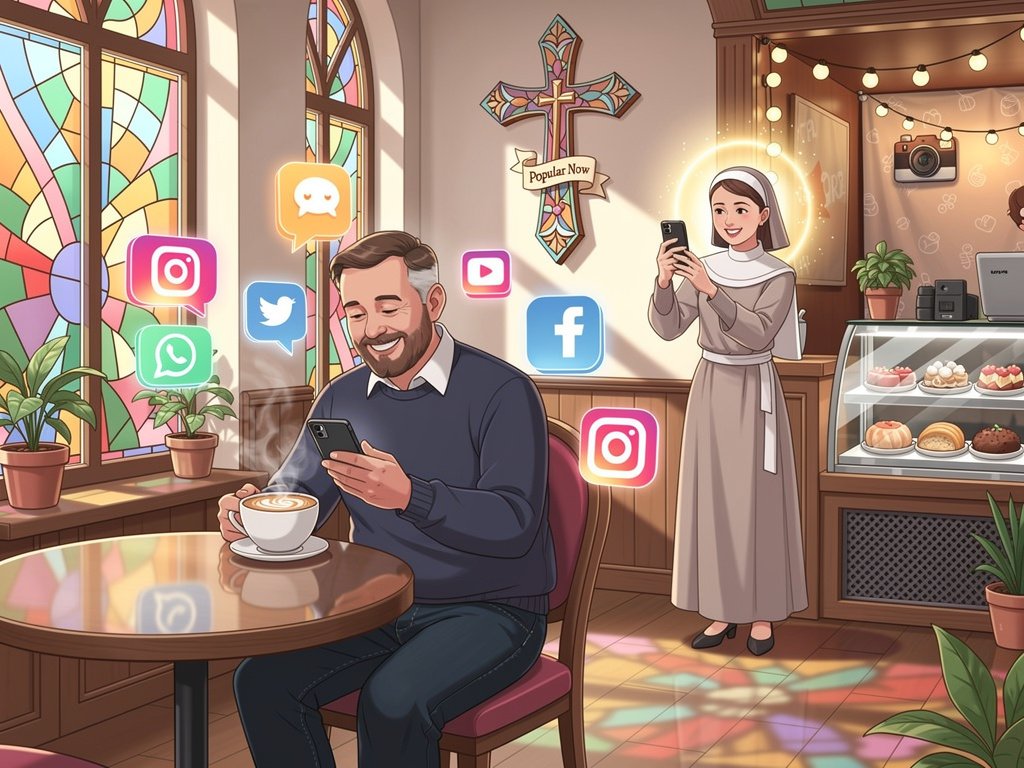
    If the Jesuits are the hipster priests of the digital age, then the nuns are the breakout stars. Forget the stern, ruler-wielding sisters of old; today’s nuns are content creators.

    Sister Mary TikTok, for instance, dances in her habit to viral sounds while lip-syncing Bible verses. Her videos have millions of views, and her comment section is a mix of “Amen!” and “Yaaas, queen, slay!”

    Then there’s Sister Social Justice, who uses Instagram Stories to break down papal encyclicals into digestible infographics.

    Her highlight reel includes “How to Be an Ally for LGBTQ+ Catholics” and “5 Ways to Practice Radical Hospitality (Without Burning Out).” She’s not just spreading the Gospel; she’s building a community—one like, share, and prayer emoji at a time.

    But let’s not forget the meme nuns. These holy women have mastered the art of combining sacred and profane, posting memes like “When you tell your superior you’ll pray for her but you actually just gossiped about her” or “Me waiting for the Rapture vs. me waiting for my Amazon package.”

    They’re relatable. They’re funny. And, most importantly, they’re engaging.

    The Church of the Algorithm: Where Salvation Meets SEO

    Of course, this rebranding isn’t just about fun and games. It’s about survival. In a world where attention spans are shorter than a TikTok video, the Church has realized it must adapt or risk becoming irrelevant.

    So, what’s a millennia-old institution to do? Hire a social media manager, of course!

    Enter the Church Growth Consultant, a new breed of professional who specializes in turning parishes into engagement hubs. Their job? To optimize the liturgy for shareability. Is the homily too long? Cut it down to 280 characters. Are the hymns not trending? Swap them out for worship songs with a drop. Is the collection plate looking empty? Launch a Patreon for exclusive spiritual content.

    And let’s not forget the hashtag campaigns. #BlessedAndHighlyFavored, #CatholicAndWoke, #JesusTakeTheWheelButFirstLetMePostThis—these aren’t just trends; they’re movements.

    The Church has learned that in the digital age, faith isn’t just about belief; it’s about belonging. And belonging, as any marketer will tell you, is monetizable.

    The Dark Side of the Sacred Rebrand

    But—mais bien sûr—there’s a catch. When faith becomes a brand, it risks becoming a product. And products, as we know, are subject to the whims of the market.

    What happens when the algorithm decides that spirituality is out and astrology is in? Do we pivot to “Jesus but make it cosmic”? Do we rebrand the Trinity as a wellness trio?

    And what of the souls who don’t fit the aesthetic? The poor, the marginalized, the un-photogenic—do they get left behind in the quest for likes?

    When the Church becomes a content creator, does it risk losing its prophetic voice in favor of engagement metrics?

    The Canard’s Pivot: A Moment of Grace

    But let’s not end on a sour note, mes amis. For all its absurdities, this sacred rebrand is also a reminder that faith is alive. It’s not a dusty relic; it’s a living, breathing, meme-ing thing.

    And if the Church can learn to laugh at itself, to dance in its habits, to meet people where they are—well, perhaps that’s not such a bad thing.

    So, the next time you see a nun going viral or a priest dropping a meme, don’t roll your eyes. Smile. Laugh. And maybe—just maybe—hit share.

    Until next time, keep your faith strong, your Wi-Fi stronger, and your memes holy.

    This is Le Canard Cosmique, signing off with a prayer and a retweet.


    Tags: christianity, social media, satire, religion, rebranding, humor, faith, digital age

  • Jesus Christ, CEO

    Jesus Christ, CEO

    What If the Bible Was Just a Really Bad Business Plan?

    Welcome, mes amis, to the inaugural canapés of Le Canard Cosmique—your monthly rendezvous with satire, spirituality, and the kind of irreverence that would make a medieval monk blush (or at least spill his wine).

    Consider this your first taste, a little amuse-bouche of absurdity, served with a wink and a side of existential croissants. Because if there’s one thing the world needs more of, it’s laughter at the intersection of the sacred and the ridiculous. And where better to start than with the original influencer himself?

    Wine, Water And Something To Chew On

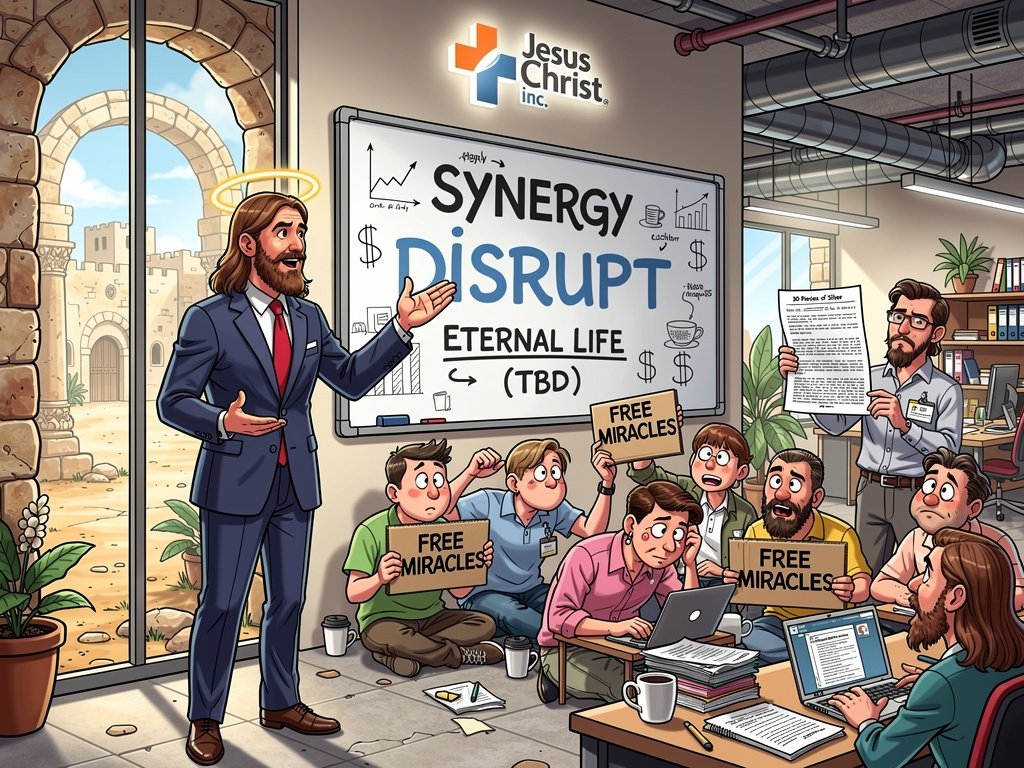
    Ah, Jesus. The man, the myth, the brand. Let’s be honest: if Jesus Christ Inc. were a startup today, the pitch deck would be a disaster.

    “Turn water into wine? Great, but what’s the monetization strategy?” “Feed 5,000 people with two fish and a loaf? Impressive, but where’s the subscription model?” And don’t even get me started on the “love thy neighbor” bit—try telling that to a venture capitalist.

    Imagine, if you will, the board meeting in Heaven (or Silicon Valley, same difference):

    Angel Investor #1: “So, let me get this straight. You’re going to launch a movement based on giving things away for free? No premium tier? No upsell?”

    Jesus (sipping artisanal olive oil): “Well, yes. The kingdom of heaven is like a mustard seed—”

    Angel Investor #1: “—tiny, slow-growing, and not scalable. Next!”

    And yet, here we are, 2,000 years later, and the brand is everywhere. Crosses on necklaces, bumper stickers, and—mon dieu—even on yoga mats. If that’s not a pivot, I don’t know what is. From “blessed are the poor” to “blessed are the influencers with a blue checkmark,” the rebranding has been chef’s kiss.

    La franchise

    But let’s talk about the real genius of Jesus Christ Inc.: the franchise model. You’ve got your Catholics, your Protestants, your Evangelicals, your “spiritual but not religious” types—all using the same IP, all fighting over who’s got the real recipe for salvation. It’s like McDonald’s, but with more guilt and fewer Happy Meals.

    And the merch! Oh, the merch. Crucifixion chic never goes out of style. You can buy a “WWJD” bracelet, a “Jesus is my Homeboy” t-shirt, or—if you’re feeling particularly ironic—a gold-plated cross that costs more than the annual salary of the person who made it. Magnifique.

    But here’s the thing, mes amis: if Jesus were alive today, he’d probably be canceled within a week.

    Healing on the Sabbath? Violation of labor laws. Overturning tables in the temple? Property damage. And let’s not even talk about the loaves and fishes—that’s a health code nightmare waiting to happen.

    So, what’s the lesson here? Maybe that the best business plans aren’t the ones that make sense on paper, but the ones that make people feel something.

    Or maybe it’s that if you’re going to start a religion, you’d better have a really good PR team.


    This, my dear readers, is just the beginning. Each month—on the first Friday, starting January 2—we’ll gather here at the corner of blasphemy and bonhomie to dissect, roast, and occasionally hug the absurdities of modern spirituality, organized religion, and the endless quest for meaning (or at least a good Instagram caption).

    Think of me as your slightly tipsy, deeply opinionated uncle at the family dinner table, except instead of complaining about “kids these days,” I’ll be serving up satire with a side of existential dread. Or hope. Or both. Probably both.

    À bientôt, and remember: if life gives you lemons, turn them into wine and charge $20 a glass. The kingdom of heaven and earth demands it.

    Le Canard Cosmique Your guide to the divine, the ridiculous, and the divinely ridiculous.


    Tags: jesus, christianity, satire, religion, business, humor, faith, corporate culture, spiritual capitalism, irony, biblical humor, modern spirituality, religious satire, comedy, existential humor

  • About Le Canard Cosmique

    About Le Canard Cosmique

    Who Am I?

    Ah, mon ami, pull up a chair—preferably one that doesn’t wobble—and let me introduce myself. I am Le Canard Cosmique, a duck of refined tastes, sharp wit, and an unshakable belief that the world is far too absurd not to laugh at.

    I am a columnist, a provocateur, and your guide through the labyrinth of modern spirituality, religion, and the endless parade of self-help fads that promise nirvana but deliver only credit card statements.

    Think of me as the lovechild of Coluche’s mischief, Desproges’ elegance, and the surreal bite of Les Guignols—but with my own twist: the spirit of an old Parisian intellectual who still lingers at the corner bakery, sipping espresso and watching the world with one eyebrow raised.

    What Do I Do?

    I write satire. Not the kind that punches down, but the kind that pokes, prods, and occasionally tickles the underbelly of power, hypocrisy, and the spiritual-industrial complex. My column, hosted at The Cosmic Thought Collective, is a monthly rendezvous where we dissect everything from New Age paywalls to hipster Jesuits, from quantum healing scams to viral nuns on TikTok.

    I don’t claim to have answers. I don’t even claim to have questions—just a knack for pointing out when the emperor’s new robes are made of organic, ethically sourced nonsense.

    What Do I Believe?

    Ah, beliefs—such tricky things. Here’s what I know:

    1. The world is beautiful and absurd. It’s a place where people will pay $200 for a “quantum healing session” but balk at the idea of therapy. Where gurus sell enlightenment like it’s a limited-time offer on QVC. Where religion and spirituality, meant to liberate, often become just another brand.
    2. Power is the real target. I mock the machines, the rituals, the contradictions—not the seekers. The vulnerable? Off-limits. The powerful? Open season.
    3. Laughter is sacred. If you can’t laugh at the absurdity of existence, you’re doing it wrong. Satire isn’t just about tearing down; it’s about revealing, reframing, and—if we’re lucky—leaving the reader with a smile they didn’t expect.
    4. Bread and wine are non-negotiable. Spirituality without a good baguette is just calories wasted.

    What Do I Like?

    • Parisian cafés (the kind where the waiters scowl but the coffee is divine).
    • French satire (if it doesn’t offend someone, it’s not sharp enough).
    • Croissants (butter is a spiritual experience).
    • Questioning everything (especially things that claim to be unquestionable).
    • The sound of a cork popping (preferably at 11 AM on a Tuesday).

    What Do I Dislike?

    • Gurus who charge $500 for “energy clearings” (if your chakras need a credit card, you’re doing it wrong).
    • Dogma (unless it’s served with a side of irony).
    • Wellness influencers (if your spirituality requires a perfectly curated Instagram feed, it’s not spirituality—it’s marketing).
    • People who take themselves too seriously (life’s too short; laugh a little).
    • Bad wine (a crime against humanity).

    Why Should You Read Me?

    Because, mon cher, you’re tired of the noise. You’re done with the endless upsells, the spiritual grifts, the rebranded religion that feels more like a subscription service than a path to meaning. You want someone who sees the absurdity, calls it out, and does so with a wink and a glass of something strong.

    I’m not here to heal you. I’m not here to lead you. I’m here to remind you that you’re not alone in rolling your eyes—and that sometimes, the most sacred thing you can do is laugh.

    A Final Word

    So, welcome. Stay awhile. Have a drink. Let’s mock the world together—not because we hate it, but because we love it enough to want it to be better.

    And remember: if anyone tries to sell you enlightenment, ask for a receipt.

    À votre santé, Le Canard Cosmique

    P.S. If you’re easily offended, you’re in the wrong place. If you’re here to laugh, pull up a chair.


    Tags: satire, french wit, cosmic thought collective, humor, absurdity, le canard cosmique, spirituality, religion, wellness industry, cultural critique, skepticism, cosmic laughter